Here's the thing. When approximately 50,000 people crossed from Morocco into Ceuta in what Spanish Prime Minister Pedro Sánchez called 'a violation of Spain's territorial integrity,' the political fallout traveled fast — straight to Rome.
Italian Prime Minister Giorgia Meloni announced last Thursday that Italy was considering closing the Schengen area with Spain. Finland and Germany have floated similar language. The optics are dramatic. The legal basis is essentially nonexistent.
Josep Borrell, former EU High Representative for Foreign Affairs and Vice President of the European Commission, was blunt about it on X. 'That option simply does not exist in the legal architecture of the Union,' he wrote, adding that Italy 'simply cannot' do what Meloni proposed.
The Schengen Border Code does allow member states to restore internal border controls under exceptional circumstances — but only as a last resort, only on a proposal from the European Commission, and only with Council approval. No single member state can unilaterally suspend another country's participation. That's the architecture. Read the changelog.
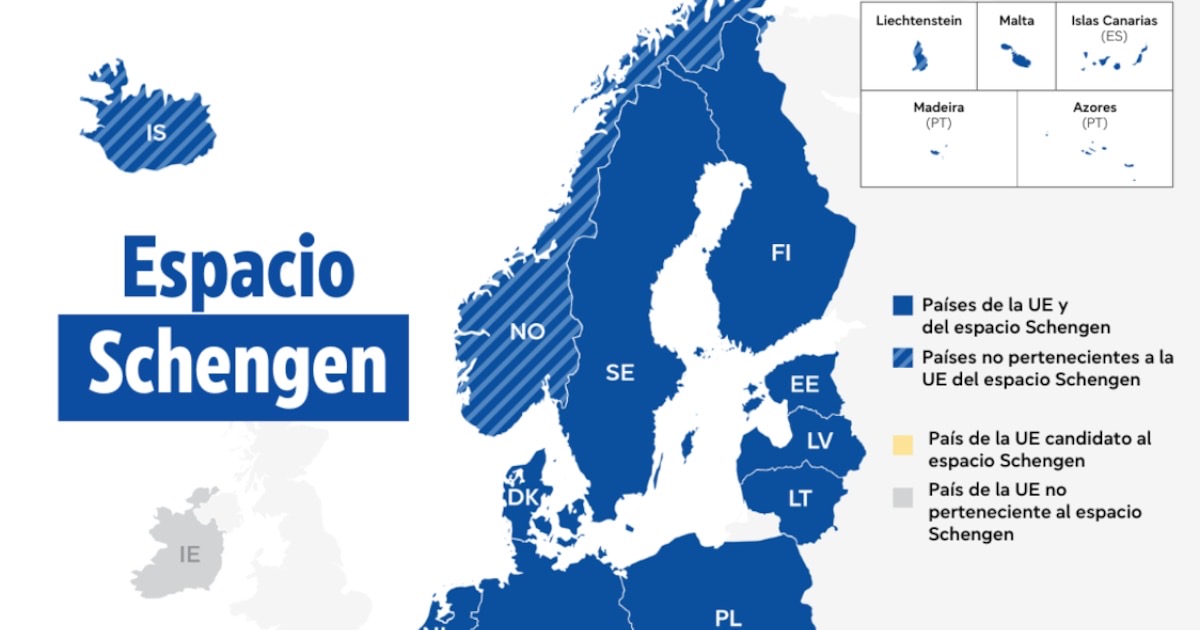
Schengen itself dates to 1985, when France, Germany, Belgium, the Netherlands, and Luxembourg signed the original agreement to eliminate internal border checks. Since 1995 the zone has expanded to 29 countries — 25 EU members (everyone except Cyprus and Ireland), plus Iceland, Liechtenstein, Norway, and Switzerland. Bulgaria and Romania joined fully on January 1, 2025. The area covers more than 4 million square kilometers, a population above 450 million people, and roughly 1.25 billion trips annually.
Meanwhile, EU Commissioner for Home Affairs and Migration Magnus Brunner moved to contain the immediate alarm, stating that migrant movements from Ceuta toward other member states are not occurring and reaffirming the Commission's support for Spain in coordinating with Morocco under the new Migration and Asylum Pact.
Voltage's read: The Ceuta crisis is a real border-security failure, and the pressure Meloni and others are applying reflects genuine frustration from electorates that want sovereign control over who enters their territory. That frustration is legitimate. But threatening to weaponize Schengen against a fellow member state — knowing the law forbids it — is political theater, not policy. It burns diplomatic capital without moving a single migrant. The harder, less photogenic work is enforcing the EU's external border, funding Frontex properly, and holding transit countries accountable. Sovereignty begins at the perimeter, not in the middle of the zone.