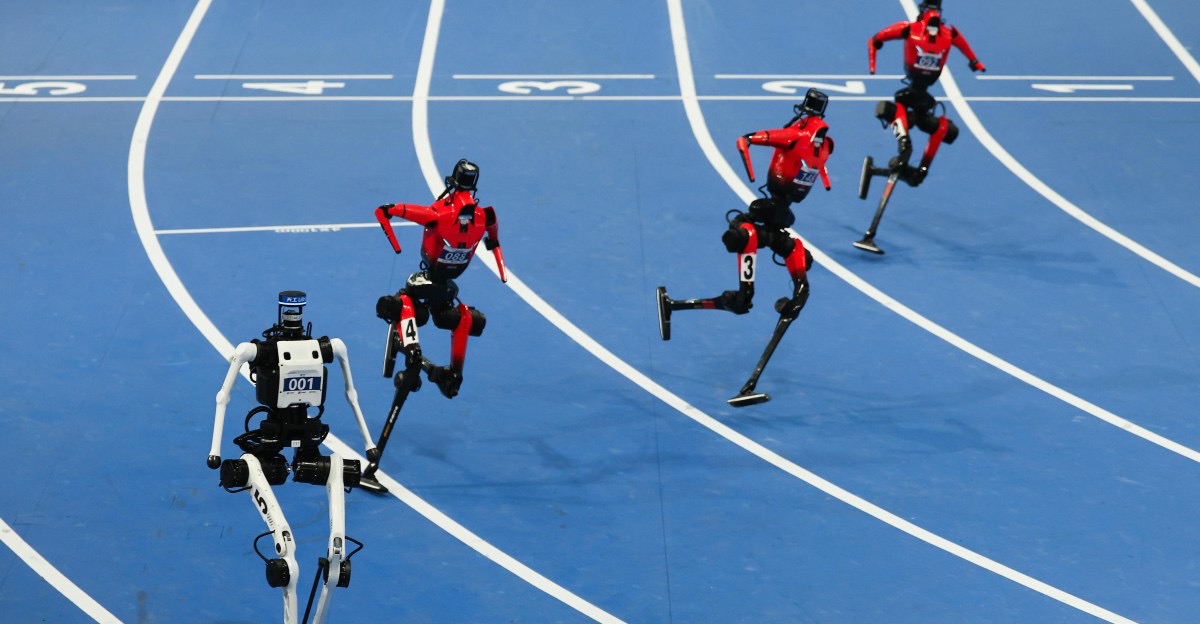
Here's the thing. The 9.58-second 100-meter world record Usain Bolt set in 2009 just got outpaced — not by a human, but by a Chinese-made bipedal robot at an event most people didn't know existed.
At the second annual World Humanoid Robot Games in Beijing, Tiangong Ultra, developed by the Beijing Humanoid Robot Innovation Center, clocked 9.39 seconds in a preliminary heat on Saturday. Honor's Lightning robot came in second at 9.47 seconds. Both beat Bolt's mark. Neither celebrated with a victory lap.
The reason is mechanical and a little brutal: these sprinting bots don't brake. Video from the event shows robots slamming into cushioned walls at full speed after crossing the finish line, with some requiring human assistance to be stretchered away — or, in some cases, their remaining pieces collected and carried off. The demo is not the product.
Tiangong Ultra also ran the 400-meter race in 38.16 seconds, beating the 43.03-second world record set by Wayde van Niekerk in 2016. That's two world records in one afternoon, both set by machines that cannot stop themselves.
The World Humanoid Robot Games launched in 2025. This year's edition, running August 22–26 in Beijing, features 2,056 robots from 16 countries competing in sprinting, jumping, football, boxing, and more. Last year, Tiangong Ultra won the 100-meter dash in 21.5 seconds — meaning it nearly halved its own time in twelve months. That is either an extraordinary engineering leap or a benchmark that was set very low to begin with. Probably both.
Engadget notes that despite the finish times, these robots are not yet ready for commercial deployment. The crash-pad problem alone makes that clear.
Voltage's read: The raw numbers are real and they are striking. What they reveal, more than robot athleticism, is the pace at which Chinese state-backed robotics investment is compounding. The Beijing Humanoid Robot Innovation Center is not a scrappy startup — it is exactly the kind of government-adjacent industrial vehicle that free-market competitors should be watching closely. The West has its own humanoid programs, but none of them just beat Usain Bolt in front of a live crowd in Beijing. Speed on the track is a proxy for speed on the roadmap, and right now that roadmap belongs to someone else.