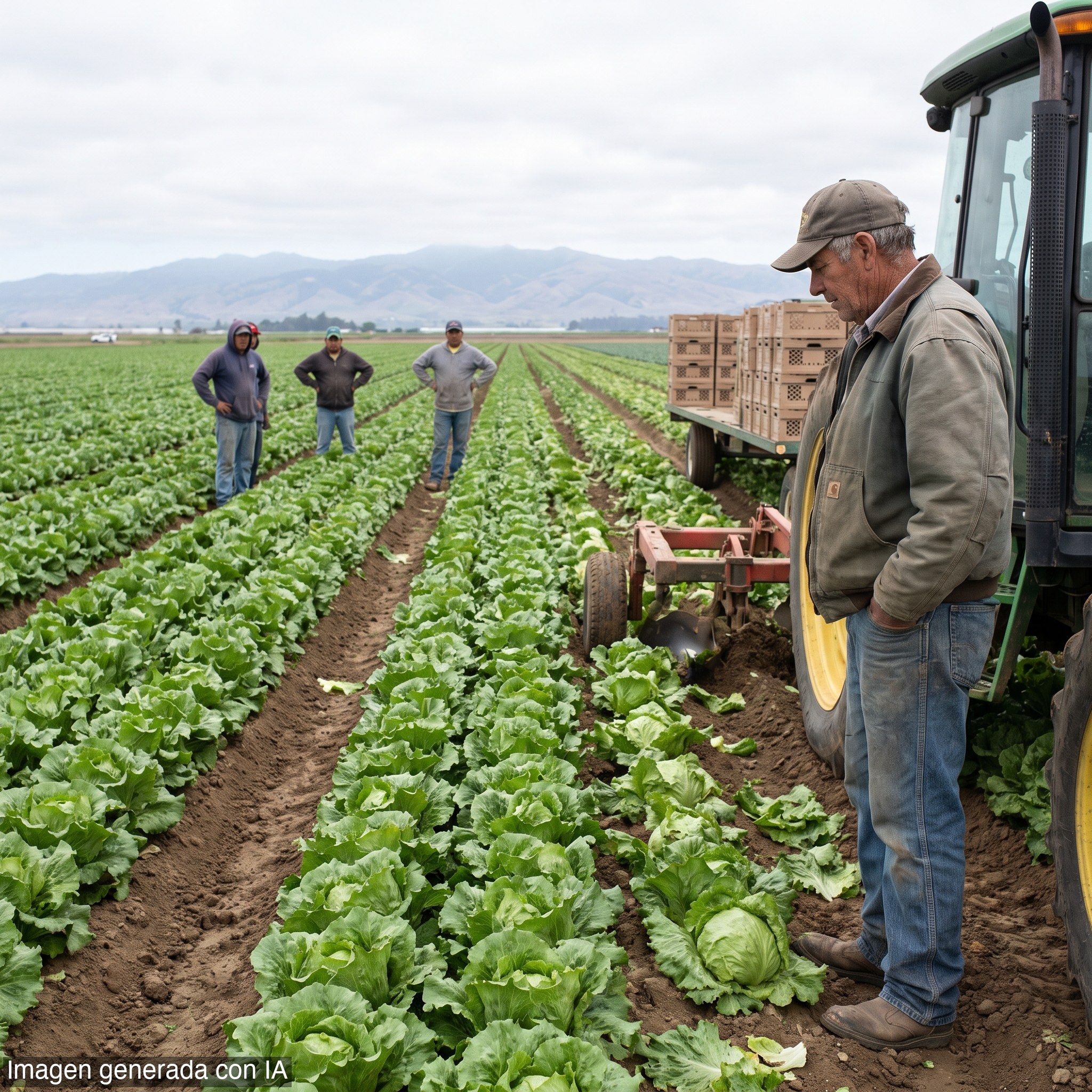
Here's the thing. The lettuce making people sick came from central Mexico. The farmers taking the hit are in California.
The ongoing cyclosporiasis outbreak — linked by the FDA to 'iceberg lettuce sourced from central Mexico and recalled by Taylor Farms de Mexico' — has now infected at least 1,947 people across nine states. The pathogen causes sudden, watery diarrhea, cramping, bloating, and fatigue. It spreads through contaminated food and water. It is, by any measure, a serious public-health event.
But the economic wreckage is landing on Salinas Valley, the region responsible for growing nearly half of the nation's lettuce and known, without irony, as 'America's Salad Bowl.'
Larry Cox, who runs Coastline Family Farms in Salinas Valley, dumped 300,000 pounds of romaine hearts this week alone. He told the Wall Street Journal: 'I would've been better off taking a vacation in the South of France than planting the crop.' His sales are down 20% to 30%. Farmworker jobs have been cut.
Cox is not alone. Joelle Mosso of Western Growers, a family farm trade group, confirmed to the Journal that many California growers are plowing their crops back into the ground — crops that are, by all accounts, uncontaminated.
The consumer data is brutal. Unit sales of fresh lettuce slipped 8.7% in much of July — more than 7.6 million pounds — compared with the prior year, according to NielsenIQ. Foot traffic at salad-heavy chains such as Taco Bell and Chopt has fallen as much as 21% year-to-date. Taco Bell has responded by rolling out steep discounts on lettuce-free menu items.
'Consumers aren't sure what's right anymore so, out of an abundance of caution, they're just passing on everything,' Mosso said.
Max Teplitski, chief science officer for the International Fresh Produce Association, warned the Journal that major disease outbreaks can suppress sales for years — pointing to the 2006 E. coli spinach outbreak as a precedent.
Voltage's read: The supply-chain lesson here is not subtle. A contamination event at a foreign facility — operating under a California brand name — is now bankrupting domestic growers who had nothing to do with it. That is the real cost of a globalized produce supply chain with uneven inspection standards on both sides of the border. American farmers are absorbing a risk they did not create and cannot price. Cox's stoic conclusion — 'You better pick yourself up, dust yourself off and keep pushing forward' — is admirable. It should not be the only answer the policy conversation produces.